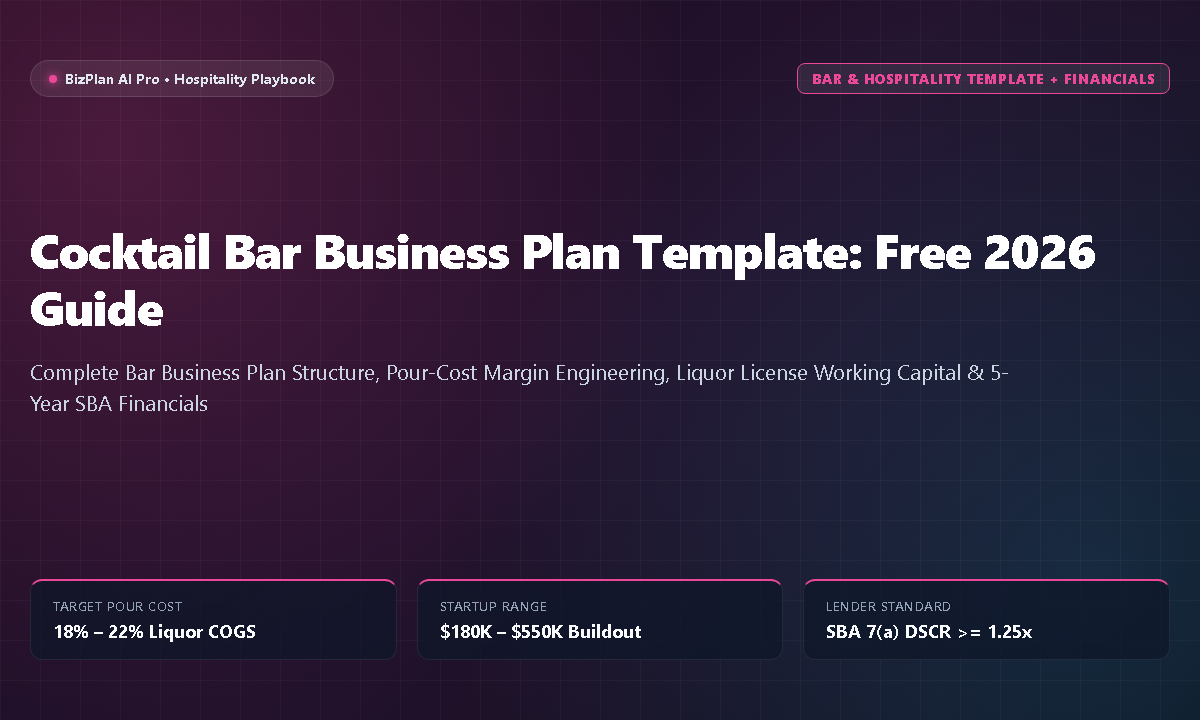
Writing a cocktail bar business plan requires far more than picking a trendy name and sketching a drink menu. Whether you are starting with a bar business plan template for a craft speakeasy, neighborhood lounge, or rooftop bar, commercial landlords and SBA 7(a) lenders scrutinize pour-cost margins, liquor license timelines, and 5-year cash flow before approving leases or loans. Use this free 2026 guide and template structure to build a bank-ready hospitality plan.
A lender-ready cocktail bar business plan must include: (1) Concept & seating capacity, (2) Local foot-traffic and demographic analysis, (3) Liquor license & Dram Shop insurance compliance, (4) Startup buildout budget ($180K–$550K), and (5) 5-year financial projections targeting an 18–22% beverage pour cost and a DSCR of 1.25x or higher.
Complete Bar Business Plan Template Outline (8 Sections)
- Executive Summary: Concept (craft cocktail lounge, taproom, or hotel bar), square footage, seat count, funding request, and 3-year revenue milestone.
- Company & Ownership Structure: LLC/S-Corp entity details, key operating partners, and prior hospitality management experience.
- Market & Location Analysis: 3-mile radius household income, evening foot traffic, nearby dining anchors, and direct competitor pricing.
- Menu & Beverage Program: Signature cocktail pricing ($14–$20), draft beer, wine-by-the-glass, and zero-proof mocktails.
- Operations, Licensing & Compliance: On-premise liquor license type, health permits, POS inventory tracking, and Dram Shop liability coverage.
- Marketing & Retention Strategy: Google Business Profile local SEO, happy-hour traffic drivers, private event buyouts, and local influencer nights.
- Management & Staffing Plan: Bar manager, lead mixologist, bartenders, barbacks, and labor-cost target (24–28% of sales).
- 5-Year Financial Projections: Startup uses of funds, monthly Year-1 P&L, Cash Flow, and break-even occupancy.
Exclusive Benchmark #1: Pour-Cost Engineering & Margin Matrix
Why bar plans get funded faster than full-service restaurants: Beverages carry higher gross margins than food. However, generic templates lump all sales into one flat COGS line. Sophisticated investors expect your bar business plan to separate beverage mix margins:
| Revenue Category | Target Pour / COGS % | Gross Margin | Inventory Control Risk |
|---|---|---|---|
| Signature Craft Cocktails | 16% – 20% | 80% – 84% | Jiggered pours & garnish spoilage |
| Draft Beer & Tap | 18% – 24% | 76% – 82% | Keg foam waste & line cleaning |
| Wine by the Glass | 24% – 30% | 70% – 76% | Oxidation loss (Coravin recommended) |
| Bar Bites / Small Plates | 28% – 34% | 66% – 72% | Kitchen prep labor & waste |
Exclusive Risk Audit #2: The 90-Day Liquor License Escrow & Working Capital Trap
What generic templates miss: Commercial landlords rarely delay rent commencement until your state alcohol board issues your final permit. In most metro markets, buildout and liquor-board approval take 60 to 120 days after lease signing. If your startup budget omits 3–4 months of pre-opening rent, insurance, and key-staff payroll, your bar can run out of cash before pouring its first drink.
Generate Your Custom Bar Financials in 10 Minutes:
Skip blank Word documents. Use BizPlan AI Pro to generate a custom cocktail bar business plan with 5-year P&L, pour-cost assumptions, and SBA 7(a) DSCR schedules—or benchmark equipment costs with our free break-even calculator.
Cocktail Bar Startup Costs & Buildout Budget ($180K–$550K)
Before submitting a bar business plan template to a commercial landlord or SBA 7(a) lender, your Uses of Funds table must itemize buildout, bar equipment, licensing, and working capital. Below is a realistic 2026 startup budget for a 2,200–3,000 sq. ft. craft cocktail bar (65–90 seats):
| Startup Expense Category | Second-Gen Bar Space | Cold Shell Buildout |
|---|---|---|
| Leasehold Improvements & Bar Millwork | $55,000 – $120,000 | $180,000 – $320,000 |
| Bar Equipment, Ice Wells & Glassware | $25,000 – $55,000 | $50,000 – $95,000 |
| Liquor License, Permits & Legal | $12,000 – $45,000+ | $15,000 – $65,000+ |
| Opening Spirits, Wine & Beer Inventory | $15,000 – $28,000 | $18,000 – $32,000 |
| POS System, Sound & Security Cameras | $8,000 – $18,000 | $12,000 – $25,000 |
| Pre-Opening Rent & Working Capital (90 Days) | $45,000 – $75,000 | $65,000 – $110,000 |
Staffing Plan & Prime Cost Benchmarks (Target < 50%)
Hospitality lenders evaluate your Prime Cost (Total Beverage/Food COGS + Total Labor). While full-service restaurants struggle to keep Prime Cost under 60–65%, a well-run cocktail bar targets a Prime Cost of 44% to 50%:
- General Manager / Bar Director: Oversees liquor ordering, weekly inventory counts, vendor rebates, and staff scheduling.
- Lead Mixologist & Bartenders: 2–3 bartenders per peak Friday/Saturday shift; tipped wage structure keeps base payroll lean while retaining high-skill talent.
- Barbacks & Door Host: Dedicated glass washing, ice replenishment, and ID compliance to maximize bartender drinks-per-hour throughput.
- Labor Cost Target: Keep total payroll, payroll taxes, and benefits between 24% and 28% of gross beverage sales.
Frequently Asked Questions
How much does it cost to open a cocktail bar in 2026?
Opening a cocktail bar typically costs between $180,000 and $550,000 depending on whether you take over a second-generation bar space or build out from a cold shell, plus local liquor license acquisition fees.
What is the average net profit margin for a cocktail bar?
Well-managed cocktail bars achieve a 10% to 18% net profit margin—higher than most full-service restaurants—because spirits and draft beverages maintain 78–84% gross margins.
Author

Related Articles