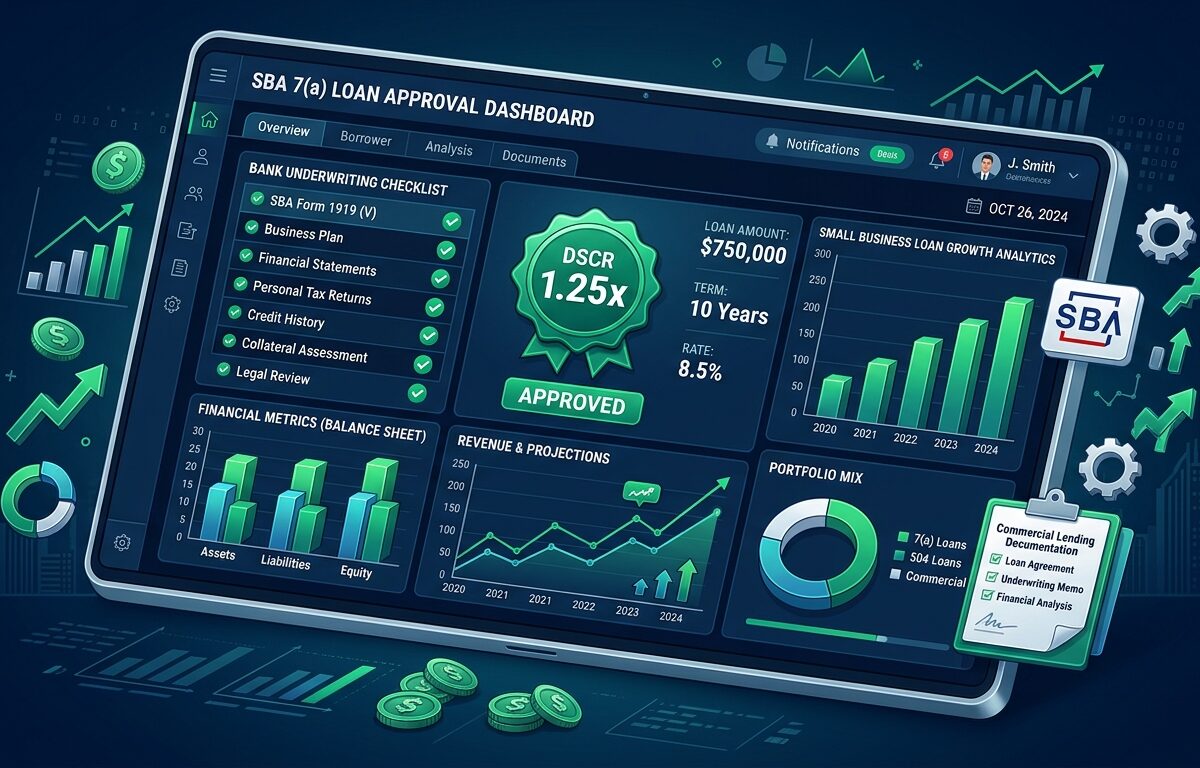
An SBA 7(a) business plan requires an executive summary detailing loan sources and uses, management resumes, market demand validation, and operational risk controls. Financially, it mandates a minimum 1.25x Debt Service Coverage Ratio (DSCR) after reasonable owner compensation, proof of a 10% to 20% equity injection under SOP 50 10 7.1, and 3-year month-by-month cash flow pro formas.
Executive Summary: What SBA 7(a) Underwriters Look For
Securing a Small Business Administration (SBA) 7(a) loan is one of the most cost-effective ways to finance a startup, business acquisition, or commercial expansion. With government-backed guarantees ranging from 75% to 85% and repayment terms spanning 10 to 25 years at regulated interest caps (typically Prime + 2.25% to 4.75%), SBA debt protects borrower equity and preserves cash runway.
However, the underwriting threshold is rigorous. Because the SBA guarantees repayment to the lender rather than lending funds directly, participating banks (such as Live Oak Bank, Huntington National Bank, Wells Fargo, and Chase) enforce institutional credit policies alongside SBA Standard Operating Procedures (SOP 50 10 7.1).
- Unsubstantiated Debt Service Coverage: Projections fail to demonstrate the required minimum 1.25x Debt Service Coverage Ratio (DSCR) after reasonable owner compensation.
- Ineligible Equity Injection: The borrower cannot document a verifiable, unencumbered 10% to 20% equity contribution using approved sources.
- Mismatched Working Capital Schedules: Pro-forma cash flow forecasts do not align with industry operating cycles, inventory turns, or realistic payment terms.
This guide provides the complete underwriting blueprint, an SBA 7(a) 6-pillar checklist, financial schedule templates, and mathematical models necessary to construct an underwriter-approved business plan.
—
Building an SBA 7(a) Loan Application?
Applying for an SBA 7(a) or 504 Bank Loan?
Skip expensive $3,000 business plan writing consultants and avoid $240/year subscription lock-in. Use the BizPlan AI Pro SBA Business Plan Generator to generate a complete, 18-section, SBA SOP 50 10 7.1-compliant business plan—including automated 1.25x DSCR calculations, month-by-month cash flow schedules, and sources-and-uses tables—for a single $15 one-time fee. Download fully editable Word and unwatermarked PDF files instantly.
Generate SBA Business Plan ($15) →—
The SBA 7(a) 6-Pillar Underwriter Checklist
When a loan package reaches credit underwriting, the credit officer evaluates the plan against six foundational criteria. Missing any single pillar halts the credit memo or triggers an onerous Request for Information (RFI).
                      ┌──────────────────────────────────────────────┐
                      │    SBA 7(a) Credit Underwriting Approval     │
                      └──────────────────────┬───────────────────────┘
                                             │
      ┌──────────────────┬───────────────────┼───────────────────┬──────────────────┐
      ▼                  ▼                   ▼                   ▼                  ▼
┌───────────┐      ┌───────────┐       ┌───────────┐       ┌───────────┐      ┌───────────┐
│ Pillar 1  │      │ Pillar 2  │       │ Pillar 3  │       │ Pillar 4  │      │ Pillar 5  │
│ Executive │      │ Management│       │ Market    │       │ Operating │      │ Financial │
│ Summary & │      │ Resume &  │       │ Demand &  │       │ Execution │      │ Model &   │
│ Sources & │      │ Track     │       │ Industry  │       │ & Risk    │      │ 1.25x     │
│ Uses      │      │ Record    │       │ Data      │       │ Controls  │      │ DSCR      │
└───────────┘      └───────────┘       └───────────┘       └───────────┘      └───────────┘
                                             │
                                             ▼
                                       ┌───────────┐
                                       │ Pillar 6  │
                                       │ Verified  │
                                       │ Equity &  │
                                       │ Collateral│
                                       └───────────┘
Pillar 1: Executive Summary & Detailed “Sources and Uses” Table
Underwriters evaluate the total project cost first. Your executive summary must state the exact legal borrowing entity, ownership structure (identifying every 20%+ owner required to provide personal guarantees), total capital requested, and an itemized Sources and Uses of Funds table that balances to the penny against SBA Form 1919.
Pillar 2: Management Capacity & Industry Experience
- Prior direct P&L responsibility in the specific sector.
- Operational duties split across principals.
- Mitigation of skill gaps through key hires, advisory boards, or franchisor operational support.
Pillar 3: Market Analysis & Verifiable Industry Benchmarks
- Defined Primary Market Area (PMA) with realistic radius (e.g., 5-mile retail or 25-mile commercial service).
- Direct competitor density matrix detailing competitor pricing, square footage, weaknesses, and market share.
- Industry benchmark ratios against which your pro-forma margins (Gross Margin, Operating Expense %, EBITDA margin) are validated.
Pillar 4: Marketing, Customer Acquisition & Operational Flow
- Explicit Customer Acquisition Cost (CAC) and conversion assumptions.
- Facility details: lease term (must equal or exceed the loan term, or include extension options), square footage, zoning status, and landlord waiver provisions.
- Supplier agreements, equipment vendor quotes, and inventory supply chain redundancy.
Pillar 5: Three-to-Five-Year Pro-Forma Financial Model
- Month-by-month cash flow forecast for the initial 12 months.
- Quarterly forecasts for Year 2; annual forecasts for Years 3 through 5.
- Three-statement integration: Profit & Loss Statement (P&L), Balance Sheet, and Statement of Cash Flows.
- Explicit break-even revenue calculation.
- Detailed Notes to Financial Assumptions defending every revenue ramp and expense item.
Pillar 6: Equity Injection Verification & Collateral Assessment
- Proof of equity injection meeting the 10% to 20% project threshold.
- Sourcing trail of all funds (minimum 60 to 90 days bank statements verifying unborrowed funds).
- Schedule of personal and business collateral offered to secure the loan shortfall (real estate, machinery, business personal property).
—
The 1.25x DSCR Benchmark: Formula, Calculation & Stress Testing
The Debt Service Coverage Ratio (DSCR) is the single most critical financial metric in SBA 7(a) underwriting. It measures the business’s ability to generate sufficient operating cash flow to service principal and interest obligations.
The SBA Underwriting DSCR Formula
$$\text{DSCR} = \frac{\text{Net Operating Income (NOI) or Adjusted EBITDA}}{\text{Annual Principal + Interest Payments (Total Debt Service)}}$$
For SBA 7(a) underwriting, underwriters calculate Adjusted EBITDA by adding back non-cash expenses and non-recurring owner personal withdrawals:
$$\text{Adjusted EBITDA} = \text{Operating Net Income} + \text{Depreciation} + \text{Amortization} + \text{Interest Expense} + \text{Officer Discretionary Add-Backs} – \text{Fair Market Owner Replacement Salary}$$
Critical Underwriter Rule: The SBA statutory baseline requires a minimum DSCR of 1.15x, but standard commercial bank underwriting guidelines for non-delegated and delegated SBA Preferred Lenders (PLP) mandate a minimum target of 1.25x. Premium lenders often look for 1.35x to 1.50x to provide a buffer against macroeconomic shocks or interest rate adjustments on variable-rate Prime-plus loans.
Step-by-Step DSCR Calculation Example
Consider a borrower applying for a $500,000 SBA 7(a) loan amortized over 10 years at an interest rate of 10.5% (Prime + 2.0%).
- Loan Amount: $500,000
- Amortization: 120 Months (10 Years)
- Interest Rate: 10.50%
- Monthly Debt Payment (P&I): $6,746.50
- Annual Debt Service: $6,746.50 \times 12 = \mathbf{\$80,958}$
To achieve the required 1.25x DSCR, the company must generate at least:
$$\text{Required Cash Flow} = \$80,958 \times 1.25 = \mathbf{\$101,198} \text{ in Available Annual Operating Cash Flow}$$
Underwriter DSCR Evaluation Matrix
| Line Item | Weak Application (<1.15x) | Target Threshold (1.25x) | Strong Application (1.45x+) |
|---|---|---|---|
| Gross Revenue | $450,000 | $550,000 | $680,000 |
| Cost of Goods Sold (COGS) | ($225,000) | ($260,000) | ($310,000) |
| Gross Profit | $225,000 | $290,000 | $370,000 |
| Operating Expenses (Excl. Depr/Int) | ($130,000) | ($145,000) | ($165,000) |
| Owner Replacement Salary | ($50,000) | ($55,000) | ($65,000) |
| Net Operating Cash Flow (Adjusted EBITDA) | $45,000 | $101,200 | $140,000 |
| Annual SBA Debt Service ($500k @ 10.5%) | $80,958 | $80,958 | $80,958 |
| Calculated DSCR | 0.56x (DECLINED) | 1.25x (APPROVED) | 1.73x (PRIME APPROVAL) |
| Coverage Surplus / (Deficit) | ($35,958) Deficit | +$20,242 Safety Margin | +$59,042 Strong Cushion |
Understanding “Global DSCR”
If the borrower owns multiple operating entities or relies on personal income to cover personal debt service, underwriters calculate the Global Debt Service Coverage Ratio:
$$\text{Global DSCR} = \frac{\text{Business Net Cash Flow} + \text{Personal Net Income}}{\text{Business Debt Service} + \text{Personal Debt Service (Mortgage, Auto, Student Loans)}}$$
If your business generates a 1.30x DSCR, but your personal balance sheet carries heavy credit card debt and a jumbo mortgage with inadequate non-business salary, your loan can be rejected on a Global DSCR basis. Your business plan must address personal financial health and document that personal draws are aligned with realistic living expenses.
—
The 20% Equity Injection Rule & Eligible Capital Sources (SOP 50 10 7.1)
Under SBA Standard Operating Procedures (SOP 50 10 7.1), minimum equity injection requirements are explicitly defined based on transaction type.
Statutory Requirements vs. Bank Realities
┌────────────────────────────────────────────────────────────────────────┐
│                   Equity Injection Requirements                        │
├───────────────────────────────┬───────────────────┬────────────────────┤
│ Transaction Type              │ SBA Minimum Rule  │ Bank Requirement   │
├───────────────────────────────┼───────────────────┼────────────────────┤
│ Complete Startup Business     │ 10% Required      │ 15% - 25% Expected │
│ Existing Business Acquisition │ 10% Required      │ 10% - 20% Expected │
│ Expansion of Existing Biz     │ Case-by-case      │ 0% - 10% Expected  │
│ Commercial Real Estate (CRE)  │ 10% Required      │ 10% - 15% Expected │
└───────────────────────────────┴───────────────────┴────────────────────┤
While the federal statutory minimum for startup enterprises is 10%, commercial credit officers routinely require 15% to 20% for startups lacking established revenue histories, uncollateralized leasehold buildouts, or franchise concepts with high failure rates.
Verified vs. Disallowed Sources of Equity Injection
Underwriters audit every dollar of equity injection through rigorous paper trails. Below is the compliance breakdown:
1. Approved Equity Sources
- Seasoned Personal Cash: Bank statements covering the most recent 60 to 90 days. Unexplained lump-sum deposits must be documented with verified source records (e.g., sale of an asset, bonus check).
- Rollovers as Business Startups (ROBS): Funds transferred from an eligible 401(k) or IRA into a C-Corporation retirement plan via qualified ERISA-compliant structures. This provides debt-free, penalty-free equity.
- Gift Funds: Permissible only from immediate family members, accompanied by a signed SBA Gift Letter stating that the funds are an absolute gift with no expectation or requirement of repayment. The lender will require bank statements verifying the donor’s ability to give.
- Standby Seller Debt (Subordinated Notes): Seller financing may count toward part of the equity injection (up to half of the required equity under SOP guidelines) only if the seller note is placed on complete standby—meaning zero principal or interest payments are made for at least 24 months, or for the entire life of the SBA loan.
- Borrowed Funds (Home Equity / Personal Loans): Permitted only if the borrower can prove through tax returns and paystubs that the debt will be fully serviced by outside, independent secondary income (such as a spouse’s salaried employment), without drawing a single dollar from the borrowing business.
2. Disallowed Equity Sources
- Unseasoned cash deposits without traceable origin (“mattress money”).
- Personal loans or credit card advances that rely on the projected business cash flow for repayment.
- Sweated equity (labor, intellectual property valuation, or unpaid pre-launch founder time).
- Promissory notes or loans from friends without formal, verified gift structures.
—
Working Capital Pro-Forma Format & Cash Flow Schedule
Underwriters scrutinize cash flow projections more than the income statement because businesses fail from lack of liquidity, not lack of accounting profit.
Below is the standard, underwriter-preferred working capital and month-by-month cash flow format for Year 1 of an SBA 7(a) loan application.
Year 1 Month-by-Month Operating Cash Flow Pro-Forma ($ in Thousands)
| Line Item | M1 | M2 | M3 | M4 | M5 | M6 | M7 | M8 | M9 | M10 | M11 | M12 | Total Y1 |
|---|---|---|---|---|---|---|---|---|---|---|---|---|---|
| Beginning Cash | $120 | $103 | $88 | $79 | $76 | $78 | $85 | $95 | $108 | $124 | $142 | $163 | $120 |
| Cash Inflows: | |||||||||||||
| Cash Sales | $15 | $22 | $32 | $44 | $55 | $65 | $72 | $78 | $85 | $92 | $98 | $105 | $763 |
| Receivables Collections | $0 | $10 | $15 | $22 | $30 | $38 | $45 | $50 | $55 | $60 | $64 | $68 | $457 |
| Total Cash Receipts | $15 | $32 | $47 | $66 | $85 | $103 | $117 | $128 | $140 | $152 | $162 | $173 | $1,220 |
| Cash Outflows: | |||||||||||||
| Direct Inventory / COGS | $12 | $18 | $24 | $31 | $38 | $44 | $49 | $53 | $57 | $61 | $65 | $69 | $521 |
| Facility Lease & Utilities | $6 | $6 | $6 | $6 | $6 | $6 | $6 | $6 | $6 | $6 | $6 | $6 | $72 |
| Payroll & Payroll Taxes | $8 | $12 | $14 | $17 | $20 | $23 | $25 | $27 | $28 | $30 | $31 | $32 | $267 |
| Marketing & Paid Ads | $4 | $5 | $5 | $6 | $6 | $6 | $7 | $7 | $7 | $8 | $8 | $8 | $77 |
| Insurance, Legal & Admin | $2 | $1 | $1 | $1 | $1 | $2 | $1 | $1 | $2 | $1 | $1 | $2 | $16 |
| SBA 7(a) Debt Service (P&I) | $0 | $5 | $5 | $5 | $5 | $5 | $5 | $5 | $5 | $5 | $5 | $5 | $55 |
| Total Cash Disbursements | $32 | $47 | $55 | $66 | $76 | $86 | $93 | $99 | $104 | $111 | $116 | $122 | $1,008 |
| Net Monthly Cash Flow | ($17) | ($15) | ($8) | ($0) | +$9 | +$17 | +$24 | +$29 | +$36 | +$41 | +$46 | +$51 | +$212 |
| Ending Cash Balance | $103 | $88 | $79 | $76 | $85 | $102 | $126 | $155 | $191 | $232 | $278 | $329 | $329 |
Note: In Month 1, SBA Debt Service reflects initial deferment or interest-only period if negotiated; normal amortization begins Month 2. Working capital reaches its trough in Month 4 ($76k remaining), demonstrating adequate liquidity buffer before cash flow turn.
3-Year Pro-Forma Summary Table
| Metric | Year 1 (Ramp-Up) | Year 2 (Stabilization) | Year 3 (Expansion) |
|---|---|---|---|
| Gross Revenues | $1,220,000 | $1,850,000 | $2,420,000 |
| COGS | ($521,000) | ($777,000) | ($992,000) |
| Gross Margin % | 57.3% | 58.0% | 59.0% |
| Total Operating Expenses | ($432,000) | ($592,000) | ($726,000) |
| Adjusted EBITDA | $267,000 | $481,000 | $702,000 |
| Officer Compensation (Salary) | ($75,000) | ($90,000) | ($120,000) |
| Operating Cash Flow for Debt Service | $192,000 | $391,000 | $582,000 |
| Annual SBA Debt Service | $60,000 | $60,000 | $60,000 |
| Annual DSCR | 3.20x | 6.51x | 9.70x |
—
Tired of Formatting Complex Excel Financial Schedules?
Applying for an SBA 7(a) or 504 Bank Loan?
Underwriters will immediately reject spreadsheets with formula errors, unlinked cash flows, or negative cash balance troughs. The BizPlan AI Pro SBA Business Plan Generator automatically synchronizes your 5-year Income Statement, Balance Sheet, and Month-by-Month Cash Flow schedules to ensure guaranteed mathematical integrity. Build your bank-ready model in under 15 minutes for $15 one-time—no subscriptions, no hidden fees.
Generate SBA Business Plan ($15) →—
SBA Loan Business Plan Template: Section-by-Section Outline
An underwriter-grade SBA business plan must be organized into clear, sequential modules. Use this standard 18-section outline when assembling your package:
1. Executive Summary & Financing Request
- Legal entity name, state of organization, date founded, and DBA.
- Specific financing request: exact loan amount, term requested (e.g., 10-year term for working capital/equipment; 25-year for commercial real estate).
- Use of proceeds table categorizing: Leasehold Improvements, Machinery/Equipment Purchases, Initial Inventory, Working Capital, and SBA Guarantee Fee.
2. Company Description & Ownership Structure
- NAICS Code and SIC Code classification.
- Capitalization table listing all equity owners with percentage ownership, SSN/EIN, and active management titles.
- Overview of core mission, customer value proposition, and operating facilities.
3. Products, Services & Pricing Strategy
- Detailed catalog of revenue lines with gross margin breakdown per unit/service.
- Pricing methodology relative to regional competitor averages.
- Proprietary technology, trademark, or franchise licensing agreements.
4. Market & Industry Analysis
- Macro industry trends validated by third-party data sources.
- Target demographic profile (B2C: median household income, population growth, traffic count; B2B: annual revenue, employee count, geographic density).
- Primary Trade Area boundaries and competitive moat.
5. Competitive Assessment & SWOT Matrix
- Side-by-side competitor benchmarking table evaluating 3 to 5 local direct competitors.
- Structured SWOT matrix: Strengths, Weaknesses, Opportunities, and Threats with actionable mitigation steps.
6. Marketing, Advertising & Customer Acquisition Plan
- Channel-by-channel marketing budget allocation (Google Local Services Ads, SEO, direct outreach, referral partnerships).
- Customer lifetime value (LTV) versus target customer acquisition cost (CAC).
- Milestone launch timeline across pre-opening, grand opening, and months 1–6.
7. Operations & Facility Plan
- Physical space specifications: square footage, lease terms, renewal options, zoning compliance, and building permits.
- Key equipment list with equipment age, vendor quotations, and depreciation schedules.
- Hours of operation, staffing schedules, and POS/ERP technology stack.
8. Management Team & Key Personnel
- Detailed executive biographies emphasizing operational and financial management experience.
- Organizational chart and hiring schedule for Year 1 through Year 3.
- Key employee compensation table and outsourced professional advisors (CPA, business attorney, insurance agent).
9. Historical Financials (For Existing Businesses or Acquisitions)
- Past 3 years of business tax returns and year-to-date interim P&L and Balance Sheet.
- Schedule of existing business liabilities and debt payoff confirmation.
- Quality of Earnings (QofE) or seller add-back normalization schedules.
10. Pro-Forma Financial Projections & Schedules
- Month-by-month cash flow for Year 1.
- 3 to 5-year Income Statements, Balance Sheets, and Cash Flow Statements.
- Break-even revenue calculations.
- Debt Service Coverage Ratio (DSCR) schedules under Base, Conservative, and Stress-Test scenarios.
11. Notes to Financial Assumptions
- Explicit line-by-line justification for revenue growth rates, wage assumptions, rent escalations, and payment terms.
12. Risk Management & Contingency Planning
- Sensitivity analysis modeling a 15% revenue drop or 10% inflation in raw material costs.
- Key-person life insurance provisions and business interruption insurance coverage.
—
4 Common Underwriter Rejections and How to Fix Them
┌───────────────────────────────────────┬───────────────────────────────────────┐
│ Common Rejection Reason               │ Mandatory Underwriting Fix            │
├───────────────────────────────────────┼───────────────────────────────────────┤
│ 1. "Hockey Stick" Revenue Ramp        │ Anchor growth rate to historical peer │
│    without marketing spend support.   │ data and show proportional CAC spend. │
├───────────────────────────────────────┼───────────────────────────────────────┤
│ 2. Unrealistic Owner Officer Salary   │ Include market-rate replacement wage  │
│    artificially inflating EBITDA.     │ ($50k-$75k minimum) in projections.   │
├───────────────────────────────────────┼───────────────────────────────────────┤
│ 3. Ineligible Equity Injection Paper  │ Season cash for 90 days or execute a  │
│    Trail (unverified deposits).       │ formal SBA Gift Letter / ROBS setup.  │
├───────────────────────────────────────┼───────────────────────────────────────┤
│ 4. Short Lease Term vs. Loan Term     │ Secure lease terms + renewal options  │
│    (lease expires before loan end).   │ matching or exceeding loan maturity.  │
└───────────────────────────────────────┴───────────────────────────────────────┘
1. The “Hockey Stick” Growth Curve
Underwriters routinely discount projections showing 300% year-over-year revenue growth without an accompanying surge in marketing spend, headcount, and working capital. The Fix: Align revenue growth with industry quartiles published by RMA or BizMiner. Tie every $10,000 increase in revenue directly to measurable customer acquisition activities in your operating budget.
2. Understating Owner Compensation to Artificially Inflate DSCR
Founders frequently zero out their own salary in pro-formas to make their DSCR appear higher. Underwriters will reject this immediately; they will insert a mandatory living expense deduction (often $50,000 to $80,000 depending on local cost of living) into your cash flow, which can collapse your DSCR below 1.25x. The Fix: Budget an appropriate owner salary from Month 1, or demonstrate verified non-business household income capable of covering personal expenses.
3. Sourcing Equity from Short-Term Borrowing
Borrowing equity from credit cards or informal peer loans creates hidden debt obligations that threaten business survival. The Fix: Ensure all equity injection is fully seasoned in your account for at least two complete billing cycles before submitting the application. If using a seller note for equity credit, ensure it has a full 24-month standby agreement.
4. Lease Maturity Mismatches
If you secure a 10-year SBA loan for leasehold buildouts, but your commercial lease is for 3 years with no contractual renewal options, the lender cannot fund the loan. The SBA requires facility control through the life of the loan. The Fix: Negotiate an initial lease term with consecutive tenant renewal options totaling at least 10 years, and include an executed Landlord’s Waiver of Lien agreement.
—
Step-by-Step Action Plan: Preparing Your SBA 7(a) Package
- Step 1: Calculate Your Total Project Cost & 20% Equity Allocation
- Step 2: Stress-Test Your Debt Service Coverage Ratio (DSCR)
- Step 3: Compile Your 18-Section Business Plan Narrative & Pro-Formas
- Step 4: Prepare Standard SBA Forms
- Step 5: Select an SBA Preferred Lender (PLP)
—
### Final Contextual Callout & Next Step
Ready to Build an Underwriter-Approved SBA 7(a) Plan?
Applying for an SBA 7(a) or 504 Bank Loan?
Don’t gamble your loan approval on a generic word processor template or pay thousands to a third-party agency. Generate a complete, compliant business plan tailored to SBA 7(a) guidelines with the BizPlan AI Pro SBA Business Plan Generator. Get full financial schedules, automated 1.25x DSCR tables, and an 18-section lender narrative for just $15 one-time with immediate export to Word and PDF.
Generate SBA Business Plan ($15) →—
Frequently Asked Questions (FAQ)
Author

Related Articles
