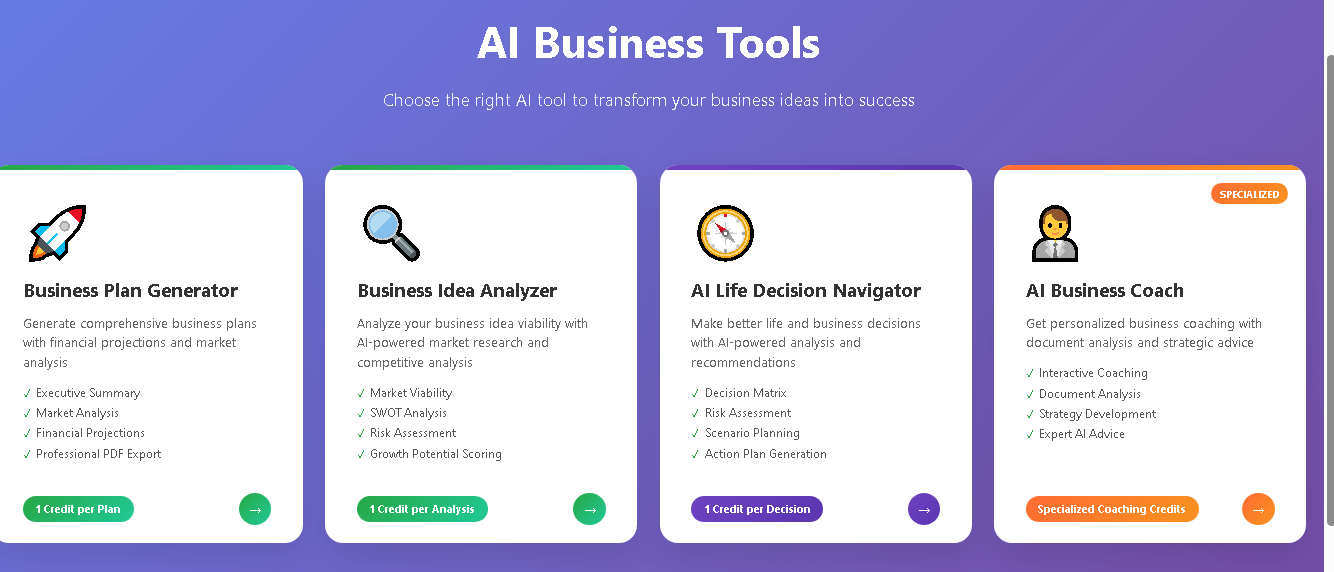
Startup Business Plan Template | BizPlan AI Pro
Introduction: What Is a Startup Business Plan Template?
A Startup business plan template is a pre‑structured document that guides entrepreneurs through the process of articulating their vision, market opportunity, operational model, and financial roadmap. Unlike a traditional business plan for an established company, a Startup plan must address the high‑velocity environment, rapid iteration cycles, and the need to attract early‑stage capital. The template serves as both a strategic blueprint for founders and a persuasive tool for investors, incubators, and potential partners.
Because startups operate under extreme uncertainty, the template emphasizes hypothesis‑driven sections—such as problem validation, minimum viable product (MVP) design, and go‑to‑market experiments—while still covering core components like market analysis, competitive positioning, and financial projections. By using a dedicated Startup business plan template, founders can ensure they capture the unique challenges and opportunities that define early‑stage ventures.
Key Sections of a Startup Business Plan
Below is a detailed breakdown of the essential components that should appear in any Startup‑focused business plan. Each section is tailored to the rapid growth, iterative development, and funding realities of early‑stage companies.
Executive Summary & Vision Statement
- Elevator Pitch: A concise 30‑second description of the problem, solution, and market.
- Mission & Vision: Long‑term impact goals that inspire investors and team members.
- Milestones: Key traction points (e.g., prototype completion, beta launch, first paying customer).
Problem Definition & Market Opportunity
- Target Pain Point: Real‑world examples, customer interviews, and quantified loss.
- Addressable Market: TAM, SAM, and SOM calculations with credible sources.
- Trend Drivers: Technological, regulatory, or cultural shifts that amplify demand.
Solution & Product Strategy
- Minimum Viable Product (MVP): Core features, development timeline, and validation metrics.
- Product Roadmap: Phase‑wise enhancements, scalability considerations, and IP strategy.
- Technology Stack: Open‑source vs. proprietary tools, cloud infrastructure, and security posture.
Business Model & Revenue Streams
Startups often experiment with multiple monetization approaches before locking in a sustainable model. Include:
- Primary Revenue Model: Subscription, transaction fee, freemium, licensing, or marketplace take‑rate.
- Secondary Streams: Data monetization, white‑label services, or strategic partnerships.
- Unit Economics: CAC (Customer Acquisition Cost), LTV (Lifetime Value), contribution margin.
Go‑to‑Market (GTM) Strategy
Because early traction is a key valuation driver, outline a clear GTM plan:
- Target Segments: Early adopters, niche verticals, or geographic pilots.
- Acquisition Channels: Content marketing, SEO, paid ads, channel partners, or viral loops.
- Growth Experiments: A/B testing framework, KPI dashboard, and iteration cadence.
Competitive Landscape & Differentiation
Map direct and indirect competitors, then highlight your sustainable advantage:
- Competitive Matrix: Features, pricing, market share, and barriers to entry.
- Moat: Proprietary data, network effects, patents, or exclusive partnerships.
- Defensibility Plan: Roadmap for strengthening the moat over 12‑24 months.
Team & Organizational Structure
Investors bet on people as much as on ideas. Provide:
- Founding Team Bios: Relevant experience, domain expertise, and prior exits.
- Key Hires Timeline: Product lead, growth marketer, head of engineering, etc.
- Advisory Board: Industry veterans, legal counsel, and technical experts.
Financial Projections & Funding Requirements
Financials for a Startup differ from mature businesses. Emphasize runway, burn rate, and milestone‑based financing.
| Metric | Year 1 | Year 2 | Year 3 |
|---|---|---|---|
| Revenue (USD) | 250,000 | 1,200,000 | 4,500,000 |
| Operating Expenses | 400,000 | 800,000 | 1,200,000 |
| Net Burn | 150,000 | 400,000 | 300,000 |
| Cash on Hand (End‑of‑Year) | 850,000 | 1,250,000 | 1,950,000 |
| Customer Acquisition Cost (CAC) | $120 | $95 | $80 |
| Lifetime Value (LTV) | $480 | $560 | $720 |
| Illustrative planning assumptions — not vendor quotes or forecasts. Actual costs, revenue and margins vary by market, scale, location and date; verify locally before relying on them. | |||
Use these projections to justify the amount of capital needed for each financing round, aligning cash infusion with product milestones and market expansion goals.
Legal, Regulatory & Licensing Considerations
Startups must navigate a distinct set of legal requirements that can vary dramatically by industry and geography. Common areas include:
- Entity Formation: Choosing between C‑Corp, LLC, or B‑Corp based on funding strategy.
- Intellectual Property (IP): Patent filing timelines, trademark protection, and open‑source licensing compliance.
- Data Privacy: GDPR, CCPA, and sector‑specific regulations (e.g., HIPAA for health tech).
- Employment Law: Equity compensation, contractor vs. employee classification, and remote‑work policies.
- Industry‑Specific Licenses: FinTech (money‑transmitter license), MedTech (FDA clearance), or EdTech (state education approvals).
How to Use & Customize Your Startup Business Plan: Step‑by‑Step Guide with Industry‑Specific Tips
Below is a practical workflow that founders can follow to adapt the generic template to the nuances of their own Startup, whether they are building a SaaS platform, a biotech venture, or a consumer marketplace.
Step 1: Define Your Core Hypothesis
- Write a one‑sentence problem statement backed by at least three customer interviews.
- Validate the hypothesis with a prototype or landing‑page test that yields a minimum conversion rate (e.g., 5% sign‑up).
- Document the results in the “Problem Definition” section to demonstrate evidence‑based thinking.
Step 2: Tailor the Product Section to Your Industry
- SaaS: Emphasize architecture scalability, API ecosystem, and subscription pricing tiers.
- Biotech: Highlight pre‑clinical data, regulatory pathway (IND, NDA), and partnership with CROs.
- Consumer Marketplace: Focus on network effects, trust‑building mechanisms (reviews, escrow), and logistics strategy.
Step 3: Build a Realistic Financial Model
- Start with a bottom‑up revenue forecast: estimate number of users, ARPU, and churn.
- Map out cost categories: R&D, cloud services, sales & marketing, and general & administrative.
- Run a sensitivity analysis (best, base, worst) to show how changes in CAC or churn affect runway.
- Insert the results into the “Financial Projections” table and annotate key assumptions.
Step 4: Align Funding Strategy with Milestones
Use the following comparison table to decide which financing instrument best matches your current stage.
| Funding Option | Typical Stage | Amount Range (USD) | Pros | Cons |
|---|---|---|---|---|
| Bootstrapping | Pre‑seed | Amounts vary by lender and borrower | Full control, no dilution | Limited runway, slower growth |
| Friends & Family | Pre‑seed | Amounts vary by lender and borrower | Quick access, flexible terms | Potential personal relationship strain |
| Angel Investors | Seed | Amounts vary by lender and borrower | Mentorship, credibility | Equity dilution, limited follow‑on capital |
| Seed Venture Capital | Seed | Amounts vary by lender and borrower | Professional support, network | Higher dilution, board oversight |
| Series A VC | Series A | Amounts vary by lender and borrower | Scale‑up resources, brand lift | Significant dilution, performance pressure |
| Strategic Corporate Partner | Series A‑B | Amounts vary by lender and borrower | Market access, co‑development | Potential IP ownership issues |
| Debt Financing (Revenue‑Based) | Growth | Amounts vary by lender and borrower | Non‑dilutive, flexible repayment | Cash‑flow risk, higher cost of capital |
| Illustrative only — funding amounts, rates and terms vary by lender, product, borrower profile, geography and date. This is not a quote or an offer; confirm current terms directly with the lender or program. | ||||
Step 5: Incorporate Legal & Compliance Checklists
Create a living document that tracks completion of each legal requirement. Below is a sample checklist for a technology‑focused Startup.
| Legal Requirement | Responsibility | Status | Deadline |
|---|---|---|---|
| Incorporate as Delaware C‑Corp | Founders | Completed | 01‑Jan‑2024 |
| File provisional patent for core algorithm | CTO & IP Counsel | In Progress | 15‑Mar‑2024 |
| Draft employee equity plan (409A) | HR Lead | Pending | 30‑Apr‑2024 |
| GDPR compliance audit | Data Privacy Officer | Not Started | 01‑Jun‑2024 |
| Obtain SOC 2 Type II certification | Security Team | Planned | 31‑Dec‑2024 |
Step 6: Iterate and Update Regularly
Unlike static business plans, a Startup plan is a living document. Set a quarterly review cadence to:
- Refresh market data and competitive analysis.
- Adjust financial forecasts based on actual burn and revenue.
- Incorporate new milestones (e.g., product launch, partnership signing).
- Update the legal checklist after each regulatory filing.
FAQs About Starting a Startup Business and Writing Its Plan
What is the difference between a traditional business plan and a Startup business plan?
A traditional plan focuses on stable revenue streams, long‑term operational details, and incremental growth. A Startup plan, by contrast, is hypothesis‑driven, emphasizes rapid validation, includes detailed milestone‑based financing needs, and often contains a higher proportion of qualitative market research and product experimentation.
How detailed should the financial projections be for a pre‑revenue Startup?
Even without revenue, investors expect a clear runway analysis. Include projected monthly burn, cash balance, and a break‑even timeline. Provide assumptions for headcount growth, cloud spend, and marketing spend, and be ready to explain how each line item ties to a specific milestone.
Do I need a full legal structure before writing the plan?
You can draft the plan with a provisional structure (e.g., “will incorporate as a Delaware C‑Corp”). However, the plan should outline the intended entity type, equity allocation, and any pending IP filings so that readers understand the legal foundation you will establish.
What are the most common funding sources for early‑stage Startups?
The most common sources, in order of typical appearance, are:
- Bootstrapping and personal savings.
- Friends & family rounds.
- Angel investors and seed accelerators.
- Seed‑stage venture capital firms.
- Strategic corporate partnerships.
- Revenue‑based or convertible note debt (for later stages).
How much equity should I allocate to an advisory board?
Advisors typically receive between 0.1% and 2% equity, vested over 12‑24 months, depending on the advisor’s reputation, time commitment, and the strategic value they bring. Document the vesting schedule in the “Team & Organizational Structure” section.
What legal documents are essential before seeking venture capital?
At a minimum, have the following prepared:
- Certificate of incorporation and bylaws.
- Founders’ Stock Purchase Agreement (FSPA) with vesting.
- Intellectual Property Assignment Agreements.
- Non‑Disclosure Agreements (NDAs) for all external engagements.
- Cap table reflecting current ownership and option pool.
Can I reuse the same Startup business plan for multiple funding rounds?
Yes, but you should treat each round as an update. Revise the executive summary, milestones achieved, and financials to reflect new data. Highlight how previous funding was deployed and the impact on traction, then articulate the next set of objectives.
How do I demonstrate traction without a large user base?
Focus on leading‑indicator metrics that signal market interest, such as:
- Number of qualified leads or demo requests.
- Pilot agreements with enterprise customers.
- Retention rates of early beta users.
- Strategic partnership letters of intent (LOIs).
- Press coverage or industry awards.
Is a pitch deck a substitute for a detailed Startup business plan?
A pitch deck is a visual summary meant for oral presentations, while the business plan provides the depth needed for due diligence. Investors often request both: the deck to gauge fit quickly, and the plan to verify assumptions and financials.
What should I do if my Startup pivots?
Update the plan immediately. Revise the problem statement, solution description, market sizing, and go‑to‑market strategy to reflect the new direction. Keep a change log so that existing investors can see how the pivot aligns with prior milestones.
Frequently Asked Questions
What is a startup business plan template?
It is a pre‑structured document that helps entrepreneurs outline their vision, market opportunity, operations, and financial roadmap for a new venture.
How does a startup plan differ from a traditional business plan?
A startup plan focuses on rapid iteration, high‑velocity growth, and early‑stage funding needs, whereas a traditional plan targets established operations and stable cash flow.
Why is a startup plan essential for attracting investors?
It clearly communicates the market problem, solution, traction metrics, and financial projections, giving investors confidence in the venture’s potential.
What key sections should be included in a startup business plan template?
Executive summary, problem statement, solution, market analysis, business model, go‑to‑market strategy, team, financial projections, and funding requirements.
How often should a startup update its business plan?
Ideally after each major milestone or market shift—typically every 3‑6 months—to reflect new data, pivots, and growth metrics.