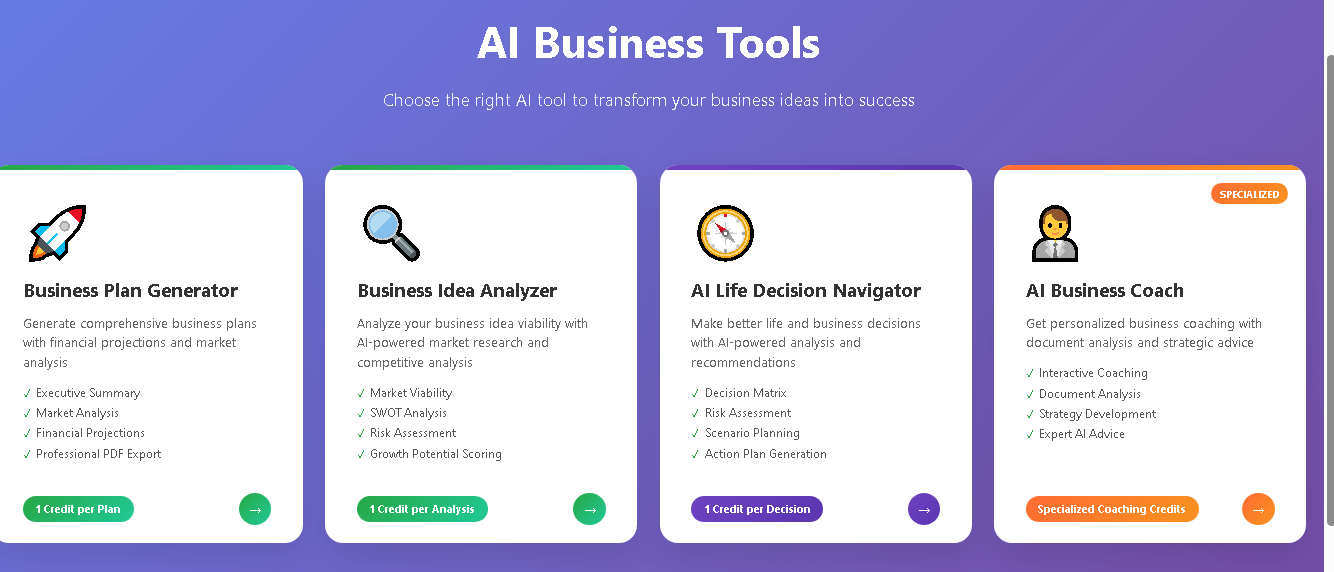
IT Startup Business Plan Template | BizPlan AI Pro
Introduction: What Is an IT Startup Business Plan Template?
An IT Startup business plan template is a pre‑structured document that guides technology‑focused founders through the process of turning a disruptive idea into a scalable venture. Unlike generic startup templates, this version zeroes in on the unique rhythm of software development cycles, rapid product iterations, and the intense capital requirements of cloud‑based services. The template serves three core purposes:
- Clarity: It forces entrepreneurs to articulate the technical problem, solution architecture, and go‑to‑market approach in a concise, investor‑ready format.
- Alignment: It aligns product, engineering, sales, and finance teams around a single strategic narrative.
- Fundability: It showcases the financial runway, IP protection strategy, and market traction metrics that VCs and angel investors demand from high‑growth IT ventures.
When customized for your specific niche—whether it’s SaaS, AI‑driven analytics, cybersecurity, or platform as a service (PaaS)—the template becomes a living blueprint that evolves with each product release and funding round.
Key Sections of an IT Startup Business Plan
Every successful IT Startup business plan contains a set of sections that reflect the sector’s technical complexity, rapid scaling potential, and regulatory landscape. Below is a detailed breakdown of each component, along with the industry‑specific data points you should embed.
Executive Summary
The executive summary is a 1‑page snapshot that captures the essence of your venture: the problem you solve, the technology stack, target market size, and the ask (funding amount, equity offered, or strategic partnership). For IT startups, include a concise “Technology Differentiator” bullet that highlights patents, proprietary algorithms, or unique cloud‑native architecture.
Problem Statement & Market Opportunity
Identify the pain point with quantitative backing—e.g., “Enterprises lose $3.5 trillion annually to data breaches” for a cybersecurity startup. Pair this with a TAM/SAM/SOM analysis that uses credible sources such as Gartner, IDC, or Statista, and illustrate the adoption curve for emerging technologies (AI, edge computing, etc.).
Technology Solution & Product Roadmap
Detail the core product architecture, preferred development frameworks, and integration points (APIs, micro‑services, SaaS platforms). Include a visual roadmap that outlines MVP, beta, and version‑1.0 milestones, each tied to measurable KPIs like latency reduction, user onboarding speed, or churn rate.
Business Model & Revenue Streams
IT startups typically monetize through one or more of the following channels:
- Subscription (SaaS) licensing – recurring monthly or annual fees.
- Usage‑based pricing – pay‑as‑you‑go for API calls, compute hours, or storage.
- Freemium → premium conversion – free tier to drive adoption, then upsell.
- Professional services – implementation, training, and custom development.
Map each revenue stream to the cost structure in the financial model to demonstrate unit economics (CAC vs. LTV).
Go‑to‑Market Strategy for IT Services
Because IT purchases are often consensus‑driven, outline a multi‑layered GTM plan that includes:
- Target personas (CTO, DevOps lead, CIO, security officer).
- Channel partners (cloud marketplaces, system integrators, VARs).
- Demand generation tactics (content marketing, developer evangelism, webinars).
- Sales cycle acceleration (proof‑of‑concept pilots, sandbox environments).
Operations & Development Process
Describe the development methodology (Agile Scrum, Kanban, CI/CD pipelines) and the operational backbone (cloud provider, container orchestration, monitoring tools). Highlight any “Menu & Operations” analogues specific to IT, such as:
- Infrastructure as Code (IaC) – Terraform or CloudFormation scripts that guarantee repeatable environments.
- Release Management – automated roll‑outs, blue‑green deployments, and rollback procedures.
- Security Operations Center (SOC) Integration – continuous vulnerability scanning and incident response.
Team & Talent Acquisition
Technology talent is the most valuable asset for an IT Startup. Provide a org chart that shows:
- Founding technical team (CTO, Lead Engineer, Data Scientist).
- Product leadership (Product Manager, UX/UI Designer).
- Growth functions (Head of Sales, Marketing Lead, Customer Success).
Include a hiring timeline aligned with product milestones and a compensation benchmark (salary + equity) sourced from recent Stack Overflow or Hired reports.
Financial Projections & Funding Strategy
Financial models for IT startups must capture high upfront R&D spend, recurring cloud costs, and rapid scaling of headcount. The following table outlines typical cost categories and industry‑average ranges for a seed‑stage SaaS startup.
| Cost Category | Typical Range (USD) | Key Drivers |
|---|---|---|
| Research & Development (software engineering) | $150,000 – $350,000 per year | Team size, technology stack, third‑party SDK licensing |
| Cloud Infrastructure (compute, storage, networking) | $30,000 – $120,000 per year | Projected user base, data throughput, redundancy requirements |
| Sales & Marketing (digital ads, events, content) | $50,000 – $200,000 per year | Customer acquisition cost (CAC), channel mix, brand positioning |
| Legal & IP (patents, software licensing, compliance) | $15,000 – $45,000 per year | Patent filing, GDPR/CCPA compliance, open‑source licensing audit |
| General & Administrative (HR, office, utilities) | $20,000 – $60,000 per year | Remote vs. physical office, HR software subscriptions |
| Illustrative planning assumptions — not vendor quotes or forecasts. Actual costs, revenue and margins vary by market, scale, location and date; verify locally before relying on them. | ||
Legal, Compliance & Intellectual Property
IT startups operate in a heavily regulated environment. The table below lists the most common legal and licensing requirements, along with the typical compliance actions you’ll need to take before you can sell to enterprise customers.
| Regulation / License | Applicability | Compliance Actions |
|---|---|---|
| General Data Protection Regulation (GDPR) | Any SaaS handling EU personal data | Data protection impact assessment, appoint Data Protection Officer, implement “right to be forgotten” workflows. |
| California Consumer Privacy Act (CCPA) | Businesses serving California residents | Consumer data request portal, privacy notice updates, opt‑out mechanisms. |
| Health Insurance Portability and Accountability Act (HIPAA) | Health‑tech or any platform storing PHI | Business Associate Agreements (BAA), encryption at rest & in transit, audit logs. |
| Software Patent & Copyright | Proprietary algorithms, unique UI/UX | File provisional patents, register copyrights, maintain a robust IP ledger. |
| Open‑Source License Compliance | Use of libraries under MIT, GPL, Apache, etc. | Conduct SPDX inventory, include attribution files, avoid license incompatibility. |
How to Use & Customize Your IT Startup Business Plan: Step‑by‑Step Guide
Below is a practical workflow that transforms a generic template into a high‑impact, investor‑ready document. Follow each step and adapt the suggested tips to your technology stack and market niche.
Step 1: Define Your Vision and Core Value Proposition
Start with a one‑sentence “elevator pitch” that captures the disruptive technology and the quantifiable benefit. Example: “We use federated learning to cut data‑labeling costs by 70 % for autonomous‑vehicle fleets.” Embed this sentence in the executive summary, the cover slide, and every stakeholder communication.
Step 2: Conduct Deep‑Dive Market Research
Leverage both primary and secondary research:
- Primary: Interviews with 10–15 target‑persona prospects, surveys on pain points, and early beta feedback.
- Secondary: Analyst reports (Gartner, Forrester), market sizing databases (Statista, Crunchbase), and competitor product sheets.
Translate raw data into charts that illustrate market growth rates (CAGR), adoption curves, and competitive positioning (SWOT matrix).
Step 3: Map the Technical Architecture
Produce a high‑level diagram that shows:
- Front‑end (React, Angular, mobile SDK)
- Back‑end services (Node.js, Go, Java micro‑services)
- Data layer (PostgreSQL, MongoDB, data lake on S3)
- AI/ML components (TensorFlow, PyTorch, model serving via Kubernetes)
- Security controls (OAuth2, JWT, encryption standards)
Explain why each technology choice aligns with scalability, cost efficiency, and talent availability.
Step 4: Build a Scalable Operations Blueprint
Detail your DevOps pipeline:
- Source control (GitHub, GitLab)
- CI/CD (Jenkins, CircleCI, GitHub Actions)
- Container orchestration (Kubernetes, Docker Swarm)
- Monitoring & observability (Prometheus, Grafana, ELK stack)
- Disaster recovery (multi‑region failover, backup policies)
Include a “Run‑book” excerpt that outlines incident response steps, which reassures investors of operational maturity.
Step 5: Populate Financial Models with Industry Benchmarks
Use the cost table above as a baseline, then adjust for your specific assumptions:
- Revenue growth: 20 % month‑over‑month for the first 12 months, then 5 % quarterly thereafter.
- Gross margin: 75 % for SaaS after the first year (due to low incremental cost).
- Burn rate: Target < 12 months runway post‑seed round.
Link each line item to a KPI (e.g., “cloud spend per active user”) to demonstrate data‑driven financial stewardship.
Step 6: Tailor the Plan for Different Stakeholders
While the core document remains the same, create three derivative versions:
- Investor Deck: Focus on market size, traction metrics, and exit potential.
- Technical Due Diligence Pack: Deep dive into architecture diagrams, code repositories, and security audit reports.
- Partner Playbook: Highlight API documentation, revenue‑share models, and joint‑go‑to‑market initiatives.
Step 7: Review, Iterate, and Prepare for Pitch Deck Extraction
Schedule a 48‑hour review sprint with advisors, potential customers, and a legal counsel. Capture feedback in a change‑log table, then update the plan accordingly. Finally, extract the most compelling slides (problem, solution, traction, financials) to build a concise 10‑slide pitch deck that aligns perfectly with the full business plan.
FAQs About Starting an IT Startup and Writing Its Business Plan
- Q: How much seed capital does an IT startup typically need?
A: For a SaaS or AI‑driven product, the average seed round ranges from $500,000 to $2 million, covering 12–18 months of runway for R&D, cloud infrastructure, and early sales hires. - Q: Do I need a patent before seeking venture funding?
A: Not mandatory, but a provisional patent can increase valuation and protect core algorithms. If the technology is hard to reverse‑engineer, focus on trade secrets and robust IP clauses in founder agreements. - Q: What is the most common revenue model for IT startups?
A: Subscription‑based SaaS is dominant, followed by usage‑based pricing for API‑centric platforms. Hybrid models (subscription + usage) are gaining traction for scalability. - Q: How do I demonstrate traction without paying customers?
A: Show metrics such as monthly active users (MAU), churn rate, Net Promoter Score (NPS), beta conversion rates, and partnership letters of intent (LOIs) from enterprise prospects. - Q: Which legal structure is best for an IT startup?
A: Most founders choose a Delaware C‑Corporation for its investor‑friendly framework, ability to issue multiple classes of stock, and clear exit pathways. - Q: What compliance frameworks should I prioritize?
A: Start with GDPR and CCPA for data privacy, SOC 2 Type II for security controls, and industry‑specific standards (HIPAA, PCI‑DSS) if you handle health or payment data. - Q: How often should I update my business plan?
A: Treat the plan as a living document—review quarterly, after each major product milestone, or when you secure a new round of funding. - Q: Can I reuse a generic startup template?
A: You can, but you must inject IT‑specific sections (technology roadmap, cloud cost model, IP strategy) to avoid a “thin” plan that investors will reject. - Q: What are the top funding sources for early‑stage IT startups?
A: Angel investors, seed‑stage venture capital firms focused on tech, corporate venture arms, and government innovation grants (e.g., SBIR, EU Horizon).
Frequently Asked Questions
What key sections should an IT startup business plan template include?
A solid IT startup plan should cover executive summary, market analysis, product architecture, development roadmap, revenue model, go‑to‑market strategy, financial projections, and funding requirements.
How does an IT startup differ from a generic tech startup in planning?
IT startups focus on software development cycles, cloud infrastructure costs, data security compliance, and rapid iteration, requiring detailed technical timelines and capital allocation beyond typical product ideas.
Why is a pre‑structured template useful for first‑time founders?
It provides a proven framework, saves time, ensures investors see critical information, and helps founders align technical milestones with business goals.
What financial metrics are most critical for an IT startup’s plan?
Burn rate, customer acquisition cost (CAC), lifetime value (LTV), monthly recurring revenue (MRR), and runway based on projected cloud hosting and development expenses.
How can an IT startup validate its product before seeking funding?
Run a minimum viable product (MVP) pilot, collect user feedback, measure engagement metrics, and demonstrate a clear path to scalability and revenue generation.